It’s been 35 years since the class of ’84 left 230 Willard Way. That class was one of the biggest of its time, graduating 27 brothers. They’ve gone on to do many things, from a naval aviator to an assistant US attorney to managing investments at a hedge fund, and much more.
Alumni Profile: Back to School for Herb Riband ’84
What was your major at Cornell and how did it prepare you for your career?
I double-majored in history and Spanish, but also took many economics courses in both the arts and ag schools. All of these, plus law school, helped prepare me for international careers in law and business, working in the US, Spain, England, and Switzerland. But it goes without saying that the most practical courses I took at Cornell were wines & spirits and human sexuality.
You’ve worked most of your professional life as an attorney and in healthcare market access and policy, and for the last 20 years you have been living in Switzerland working in the life sciences industry. Tell us about your recent work in Switzerland.
In Switzerland I worked for Amgen, the California-based biotechnology leader, and before that Medtronic, the Minnesota-based medical technology leader. My last position at Amgen was vice president international policy & government affairs, leading the company’s work in these areas outside of the United States. Before that, I was vice president value access & policy, leading Amgen’s European market access, pricing, health economics and healthcare policy activities, supporting the launch of five new medicines, as well as the company’s portfolio of existing medicines. A highlight for me was co-leading the launch of Amgen’s “Value Based Health Care” program in Europe, which developed innovative “beyond the drug” healthcare solutions and promoted healthcare policies focused on measuring and improving patient health outcomes.
Right now, you are at Stanford doing a one-year fellowship. What’s it like to go back to school mid-career and what will you take away from this fellowship program?
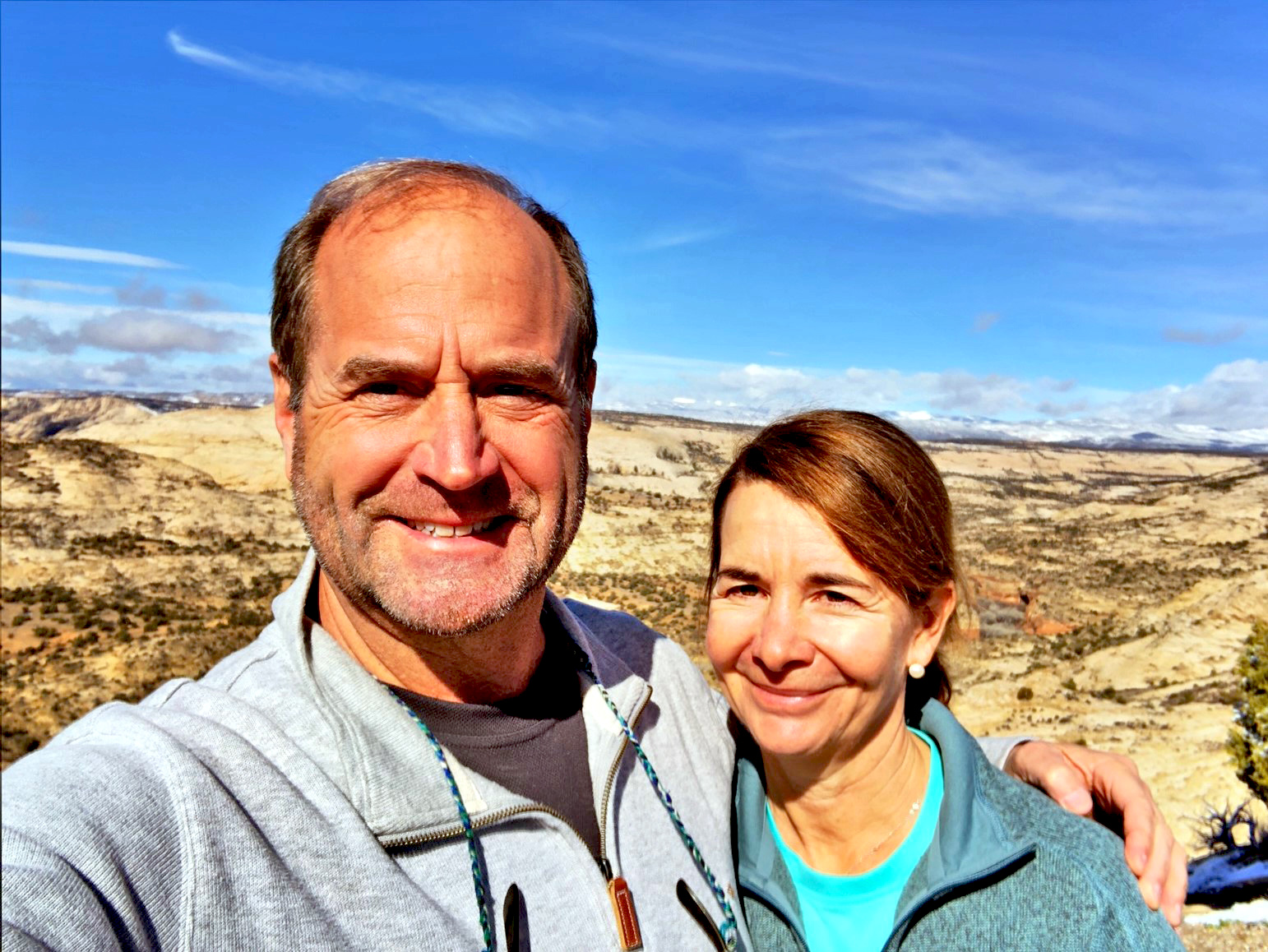
After working for 31 years, my wife, Jeanine Thomas Riband ’84, and I decided to go “back to school.” In September 2018, we embarked on a one-year DCI fellowship at Stanford University in Palo Alto, California, as part of a relatively new program to help mid/late-career people assess how they want to make unique and positive contributions for the rest of their lives. The primary focus of my fellowship is on developing new approaches and technologies to enable innovative global health and healthcare delivery models. I am hoping to generate insights, identify new solutions, and make contacts that bring together innovation projects at Stanford and in Silicon Valley with health system thought leaders from around the world. But I am also having a great time taking many other types of courses, plus giving lectures and mentoring students.
Where will you go after the fellowship ends?
Jeanine and I plan to return to our home in Lausanne, Switzerland, with frequent trips to the U.S. to visit our two children and extended families. I expect I will continue to travel around the world for both work and pleasure.
What advice do you have for undergraduates interested in a career in law and/or healthcare?
I highly recommend both, provided you find the right employers who help you develop your skills and share your values. Working as a lawyer in law firms and corporations helped me to develop strong analytical and advocacy skills and taught me how to operate at the intersection of law, ethics, and business. I have very much enjoyed working in healthcare: in addition to learning a complex, highly-regulated, technology-intensive business, I have had the satisfaction of knowing that the work my team and I did every day helped patients somewhere in the world get access to a treatment that saved or dramatically improved their lives.
How did your time at Sigma Nu prepare you for life after Cornell professionally and personally?
I was fortunate to live with a great bunch of guys, and serve as social chairman (with my roommate Mark Vanacore ’84) and then as commander. Particularly in the latter role, I learned a great deal about leadership, management, motivation, talent recruitment, and financial responsibility. The learnings came from both accomplishments and mistakes. But they have served me well.
What is your favorite memory of living at 230 Willard Way?
Too many to list: serving on an elite “Varmint Cong” unit that took apart Collegetown during the Phi Psi 500 (all for charity of course), some amazing social events (prohibition party, Bahamas party, spring break in Fort Lauderdale, spring party weekend, etc.) and, of course, working together as a brotherhood to win the fraternity all sports trophy my senior year.
Life at Sigma Nu has changed over the years. For instance, the “tube room” name is lost on younger brothers who typically watch TV in the dormer. What’s one aspect of your time at Sigma Nu that you want today’s students to know about?
I felt like we were able to maintain a “sense of balance” that included social activities, sports, academics, and volunteer activities (Big Brother program, looking after the elderly neighbor across the street, etc.). We had a group of great people who (mostly) worked hard at school, excelled at sports and other activities, and generally had a hell of a lot of fun.
Greek intramurals and the pursuit of the all sports trophy was a “big thing” at Sigma Nu while you were in school. Which team was the best Sigma Nu ever fielded; name the sport and year?
I am, of course, biased, but the 1983-’84 Sigma Nu Snakes ice hockey team was the best team I played on at Cornell. Winning the fraternity ice hockey championship was a Cornell highlight for me, especially after we beat the pretty boys from Phi Delt and the jocks from DU, which fielded three to four varsity and junior varsity hockey players in a pathetic attempt to try and stop us. We still beat the btds!
How do you stay in touch with Sigma Nu and Cornell?
Reading the Sigma News and staying in contact with some of my other brothers.
Interested brothers can connect with Herb and Jeanine at hfriband@gmail.com.
Alumni Profile: Meet John Kowalchik ’84, A Foodie for Life
What was your major at Cornell and how did it prepare you for your career?
I started out as a pre-med biology major. However, my role as a student manager at Cornell Dining and Catering made me realize my real passion was food service. I desperately wanted to become a hotelie, but the implication of having to start school over again was a non-starter. So I switched my major to food science, remaining in the ag school. As a full time student, I continued to work 40 to 50 hours a week as student coordinator of Cornell Dining throughout my junior and senior years. I truly credit the leadership experience gained as a student manager as the foundation of my career in food industry management.
You’ve worked most of your professional life in food manufacturing. Tell us about your current work as president and CEO of Baxters North America.
I joined Cincinnati-based Wornick Foods in 2001 to build a commercial business for a company with a proud history of making field feeding rations (MREs) for our nation’s warfighters. We successfully grew the business through contract manufacturing shelf stable foods for some of the world’s most iconic food brands. After several cycles of private equity ownership, the business was acquired by the Baxter Food Group in 2014. I was named CEO at that time. Baxters is a 150 year old, privately held global food company headquartered in Edinburgh, Scotland. Baxters is best known in the UK for its premium Baxters soup products. I run the North American business for Baxters, inclusive of Wornick Foods. We have four plants and over 750 employees. We have built a tremendous business focused on serving soldiers, babies, and people in crisis.
What’s your favorite Baxters product?
My favorite product is the Meal-Ready-Eat (MRE) that we have been making for the U.S. government since its inception 40 years ago. The MRE replaced the K-ration and is the foundation of our military’s field feeding program. Anyone who has served as a US warfighter readily recognizes the MRE as an integral part of their training and military experience. It is difficult to express the pride of leading an organization that is such an integral supplier to our nation’s military and the extraordinary men and women who serve our country.
What advice do you have for undergraduates interested in a career in the food business?
Some of brightest individuals that I have ever met surrounded me at Cornell. I honestly feel that most were a hell of lot smarter than me. I have learned that the food business, like any manufacturing-centric business, is a “people” business. Gaining leadership experience, whether serving as social chairman at the fraternity house or supervising a campus catering event, are valuable building blocks in learning how to effectively engage and motivate people. There is nothing more fulfilling than developing teams that routinely accomplish things together that they never thought possible. Those who thrive in leadership roles have demonstrated they can win the hearts and minds of the employees they serve. I have found that those pursuing a career in management are well rewarded by focusing on honing these “soft skills.”
How did your time at Sigma Nu prepare you for life after Cornell professionally and personally?
The years that I spent at Sigma Nu (’81–’84) were the most formative and best of my life. My first date with Eleanor Donohue ’85, my wife of 33 years, was at a Sigma Nu Bahamas party. Brothers Matt Wiant ’84, Matt Kalaycio ’84, and Mickey Harris ’84 remain my closest friends. The opportunity to live in the house for three years (and summers) provided countless memories and relationships with an incredibly diverse and talented group of young men who favorably changed the direction of the house and all of those who were fortunate to have shared the experience.
What is your favorite memory of living at 230 Willard Way?
My role with Cornell Dining and Catering provided broad access to university “assets.” They were certainly put to good use when the house put on the first annual “Spring Wing Ding,” where we served buffalo wings for charity for thousands of students on a sunny spring afternoon on the Arts Quad. Unfortunately, some brothers learned the hard way that eating cooked wings while simultaneously loading fryers with raw chicken can get you pretty sick. We are fortunate that no brothers died of salmonella.
Life at Sigma Nu has changed over the years. For instance, in the ’80s, almost everyone lived in doubles and triples, now undergraduates prefer singles. What’s one aspect of your time at Sigma Nu that you want today’s students to know about?
Our class was large (27, I think) and almost everyone lived in the house for three years. Since my roommate (Wiant) and I had the distinction of the lowest pledge numbers, we doubled up in the smallest room in the house (on the wing). Looking back, It is hard to believe we made the room work. But I never remember it feeling too small.
You have plans to be back at your 35th Reunion in June. If you could live one more day at Sigma Nu, what would that day look like?
Breakfast in the dining room, sharing the stories of the previous night. Drinking refreshments in the sun all afternoon on the house roof, Big Red hockey game, chapter room party followed by the Corner afterward. Then watching the sun rise on the roof with my best buds.
How do you stay in touch with Sigma Nu and Cornell?
Wiant, Kalaycio, Harris, and I have remained close over the years. We shared our 30th birthdays in Cabo, brought in the millenium (2000 New Years) with our families together in a mansion in Key West. Ski trips, weddings, bar mitzvahs too numerous to count. Harris, Wiant, and I even got to do a NYC-based internet start-up business together in 1999–2000. To my kids, they are “uncles.” To me, they are my best friends and always will be.
Brothers can catch up with John at jmkowalchik@zoho.com.